 Professional Laser Teeth Whitening
Professional Laser Teeth Whitening
Professional Laser Teeth Whitening
Clear guidance on what to expect from clinician-supervised cosmetic tooth whitening overing safety, realistic outcomes, alternatives, and long-term care.
Laser Teeth Whitening is a clinician-led cosmetic treatment available in the UK for adults who want a noticeable, professionally supervised improvement in tooth shade. Unlike over-the-counter kits or beauty-led services, this procedure is carried out by a registered dental professional in a regulated clinical environment.
That clinical oversight is important. Before any whitening begins, the clinician assesses overall oral health, checking for untreated decay, gum inflammation, enamel wear, cracks, and the presence of crowns, veneers, fillings, or bridges. Whitening works only on natural tooth structure, so identifying existing restorations helps ensure expectations are realistic and results are balanced.
The term "laser" refers to the use of a specialised light source to accelerate the whitening gel applied to the teeth. After protecting the gums and soft tissues, a professional-strength whitening gel is carefully placed onto the tooth surfaces. The light or laser is then used to activate or enhance the breakdown of stain molecules within the enamel and dentine. This process allows oxygen molecules to penetrate the tooth structure and lift both extrinsic staining from coffee, tea, red wine, and smoking — and certain types of intrinsic discolouration. The entire procedure is closely monitored, with controlled exposure times to prioritise safety and comfort.
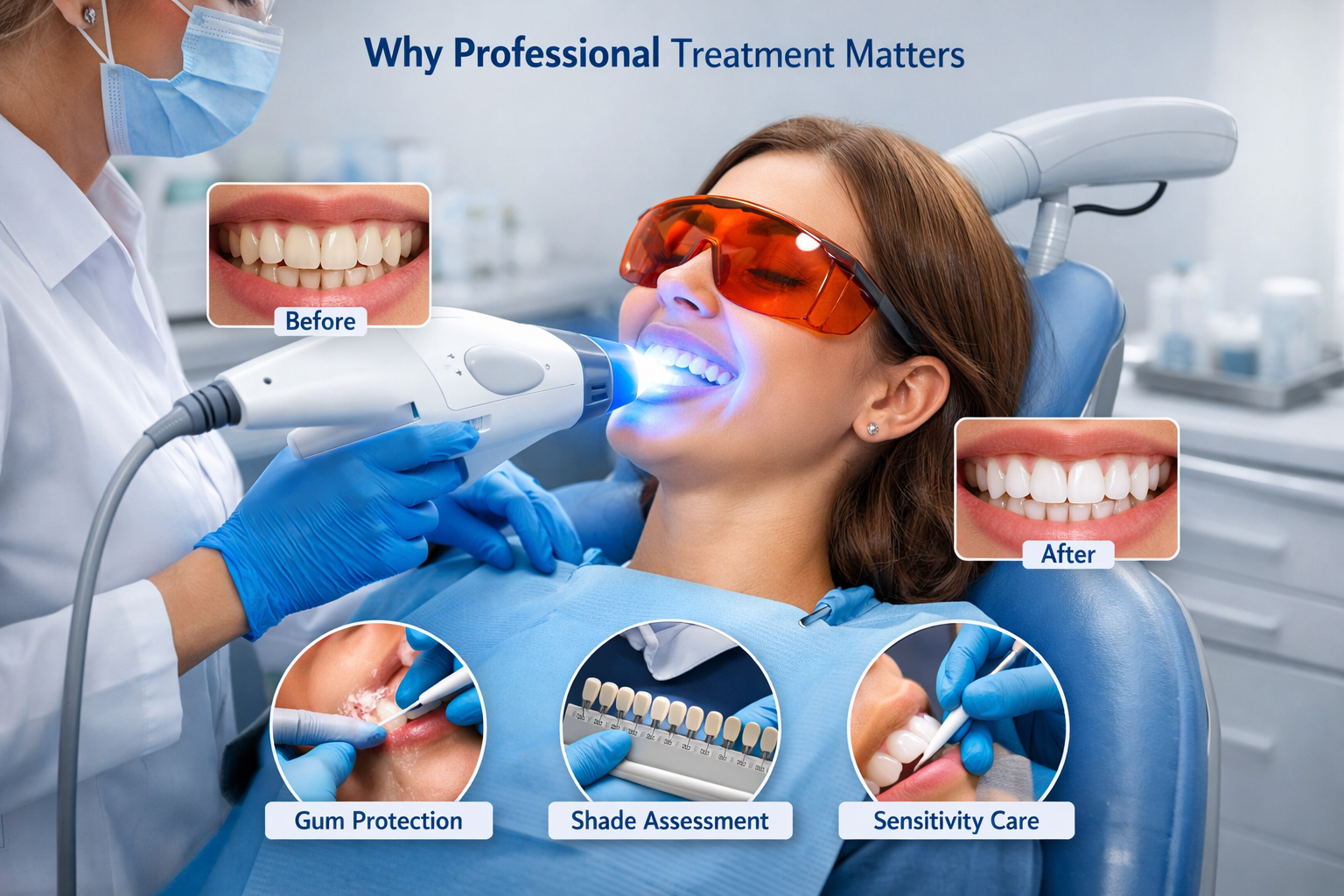
Clinician supervision ensures the correct concentration of whitening gel is selected, the gel is applied only where appropriate, and soft tissues gums, lips — are protected with barriers. It allows for immediate management of sensitivity or soft tissue irritation by reducing exposure time, using desensitising agents, or adjusting technique.
A dental professional will also check for contraindications that a layperson may not recognise, such as existing untreated decay that could allow peroxide to irritate the tooth pulp. This level of oversight is why professional whitening remains the safest and most reliable approach to cosmetic tooth shade improvement.
In the UK, whitening procedures must be carried out by, or under the direct supervision of, a registered dental professional. This ensures the treatment follows established safety guidelines while prioritising both visible results and long-term oral health.
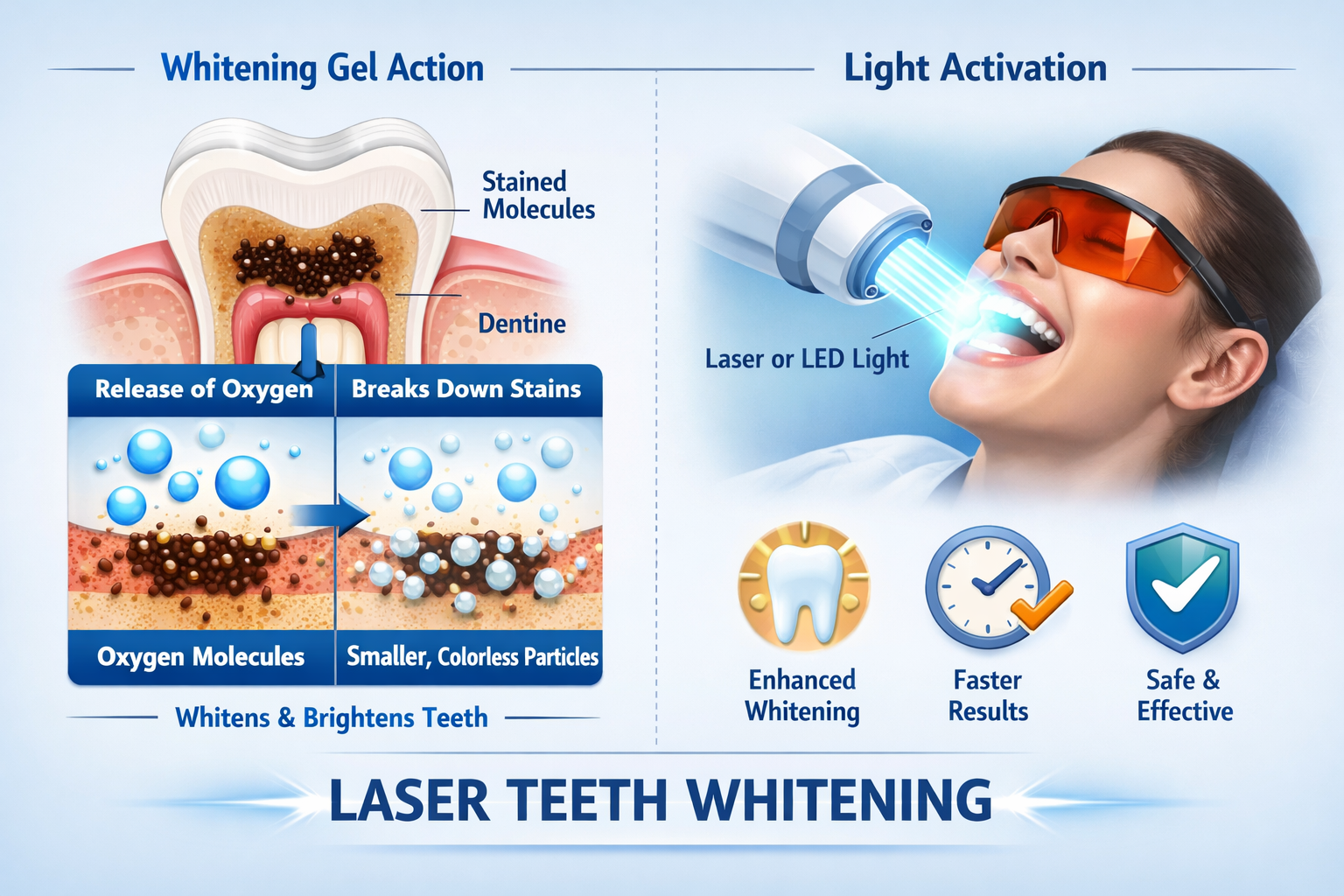
Whitening gels used in clinical practice contain peroxide compounds. Hydrogen peroxide and carbamide peroxide release reactive oxygen species that penetrate enamel and dentine, breaking apart the larger pigmented molecules responsible for discolouration into smaller, less visible fragments. The clinical effect is a gradual lightening of tooth shade as these pigmented molecules are reduced or made colourless.
Light sources marketed as lasers, LED lights, or halogen lamps are designed to supply energy that accelerates the breakdown of peroxide into active oxygen. The energy itself does not bleach teeth; rather, it increases the reaction rate of the peroxide chemistry so the desired shade is reached in a shorter time. Different devices vary in wavelength, power output, and how they couple with the whitening gel. Clinician training and device settings determine how the light is used safely.
A thorough clinical assessment is carried out and your baseline shade is recorded using a standardised shade guide and clinical photographs.
If needed, a prophylaxis is performed to remove plaque and surface deposits, providing a cleaner surface for the whitening gel.
Lip retractors and a gingival barrier are placed to protect the gums and surrounding soft tissues from contact with the gel.
The whitening gel is applied in measured amounts to the tooth surfaces, ensuring accurate and even coverage of natural enamel.
The light or laser activation is applied for defined intervals, often in repeated cycles during a single visit, to accelerate the whitening chemistry.
The gel is removed, a short rinse performed, and shade and sensitivity are reassessed to measure improvement.
Personalised advice on aftercare and possible at-home maintenance is provided to help prolong your results.
Every person considered for Laser Teeth Whitening should have a pre-treatment clinical assessment. Screening covers medical history (including pregnancy and relevant medications), a dental examination for decay or gum disease, review of existing restorations such as crowns, veneers, and composite fillings, and an assessment of current tooth colour and sensitivity history.
Adults in the UK seeking a clinician-supervised cosmetic improvement to tooth shade, particularly those with extrinsic staining from food, drink, tobacco, and lifestyle who want faster in-clinic results.
Patients who have already tried supervised take-home bleaching but want a shorter in-clinic pathway for top-up or maintenance, and individuals without extensive untreated decay, active gum disease, or high-risk oral health issues.
Existing crowns, veneers, and many fillings do not whiten with peroxide-based treatments. Where restorations are visible in the smile, the clinician will discuss how shade changes will affect overall aesthetics and whether restorative replacement or alternative approaches are more appropriate.
Age, enamel wear, and intrinsic staining — for example, from certain childhood antibiotics or trauma — can limit the degree of change achievable. A clinician will set realistic expectations during the initial consultation.
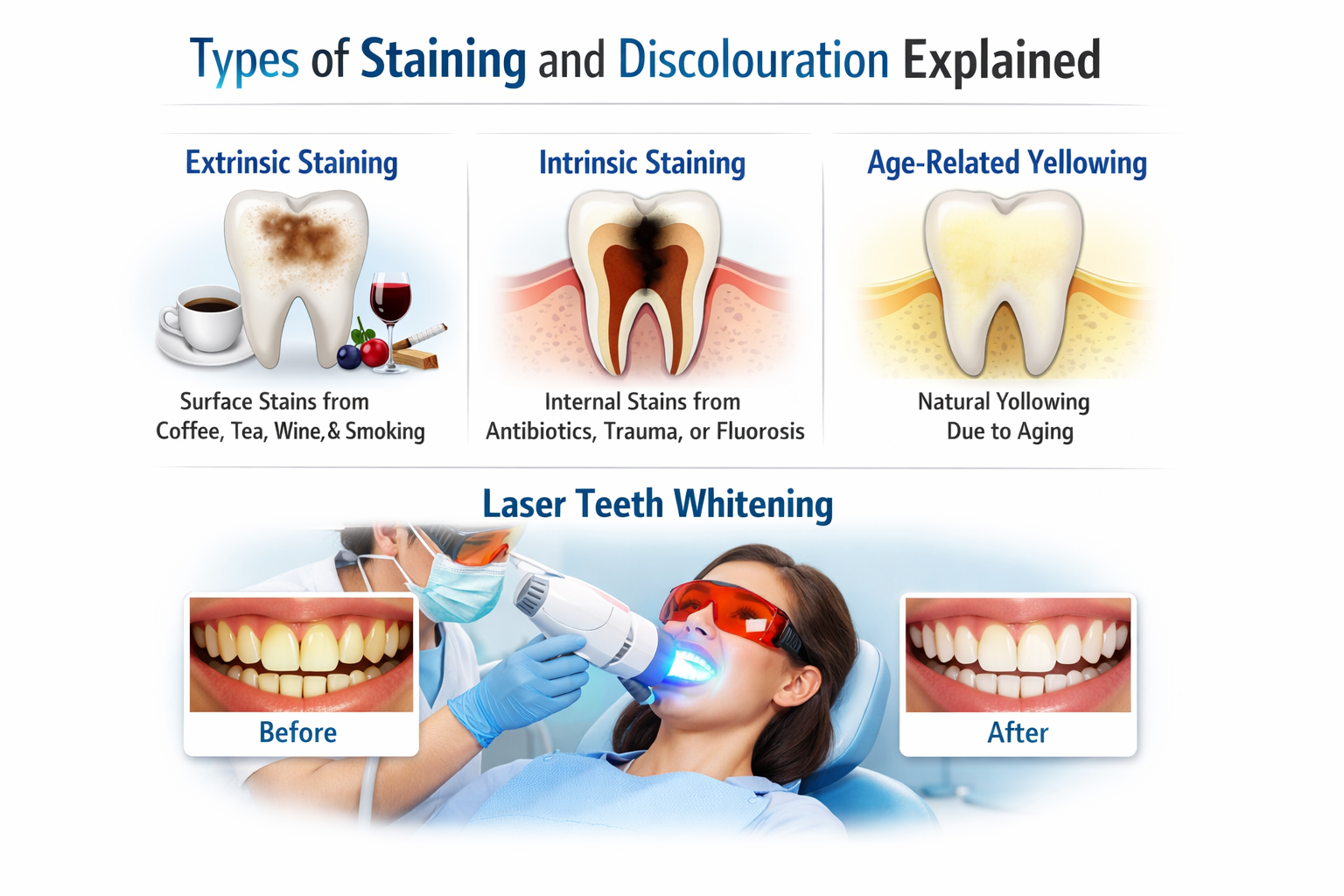
Understanding the nature of tooth discolouration helps explain why outcomes vary between patients and why a clinical assessment is an essential first step.
Extrinsic stains develop on the outer surface of the tooth from regular contact with strongly pigmented food and drink — including coffee, tea, red wine, and berries — as well as tobacco use. These stains usually respond well to professional whitening because the pigmented compounds sit on or near the enamel surface, where the whitening gel can most effectively break them down.
Intrinsic stains originate deeper within the tooth structure and may result from factors such as certain childhood antibiotics, dental trauma, or fluorosis. These stains respond less predictably to peroxide-based treatments and may require alternative approaches or a combined treatment plan to achieve a noticeable improvement.
Over time, natural changes in enamel thickness and dentine colour contribute to a gradual yellowing of the teeth. Age-related yellowing often lightens more readily than grey-toned intrinsic stains, though the degree of improvement depends on each individual's starting shade and overall tooth condition.
When choosing a professional whitening approach, the decision depends on your priorities, oral health history, and aesthetic goals. A registered dental professional will recommend the most suitable option based on a thorough assessment.
| Approach | Advantages | Considerations |
|---|---|---|
| Laser / Light-Assisted In-Clinic | Faster visible change in a single appointment. Performed under direct clinical supervision with predictable application and monitoring for sensitivity. | May be more costly than home options. Not all stains respond equally. Light systems vary, and evidence for added benefit over non-light in-clinic systems is mixed. |
| In-Clinic Non-Laser | Clinician control over gel strength and exposure time. Effective for many patients. Avoids light source if not desired. | Sessions may be longer. Still requires clinician visits. Similar limitations regarding restorations and intrinsic staining. |
| Supervised Take-Home Trays | Gradual change with lower concentration peroxide reduces acute sensitivity for some patients. Convenient for at-home use. Good for maintenance. | Requires patient compliance over days to weeks. Slower results. Less immediate visual change. |
Preparation and protection typically takes 10–20 minutes, during which soft tissue barriers are placed and the lips are retracted. Gel application and light cycles run for approximately 30–60 minutes. Depending on the system and protocol, the clinician may apply gel and run a light cycle several times in the same session. A post-treatment check of 5–15 minutes follows, during which the gel is removed, teeth are rinsed, shade is re-recorded, and sensitivity is assessed.
Some patients receive a single in-clinic session for a visible improvement; others may need one or more follow-up sessions or a supervised at-home maintenance protocol.
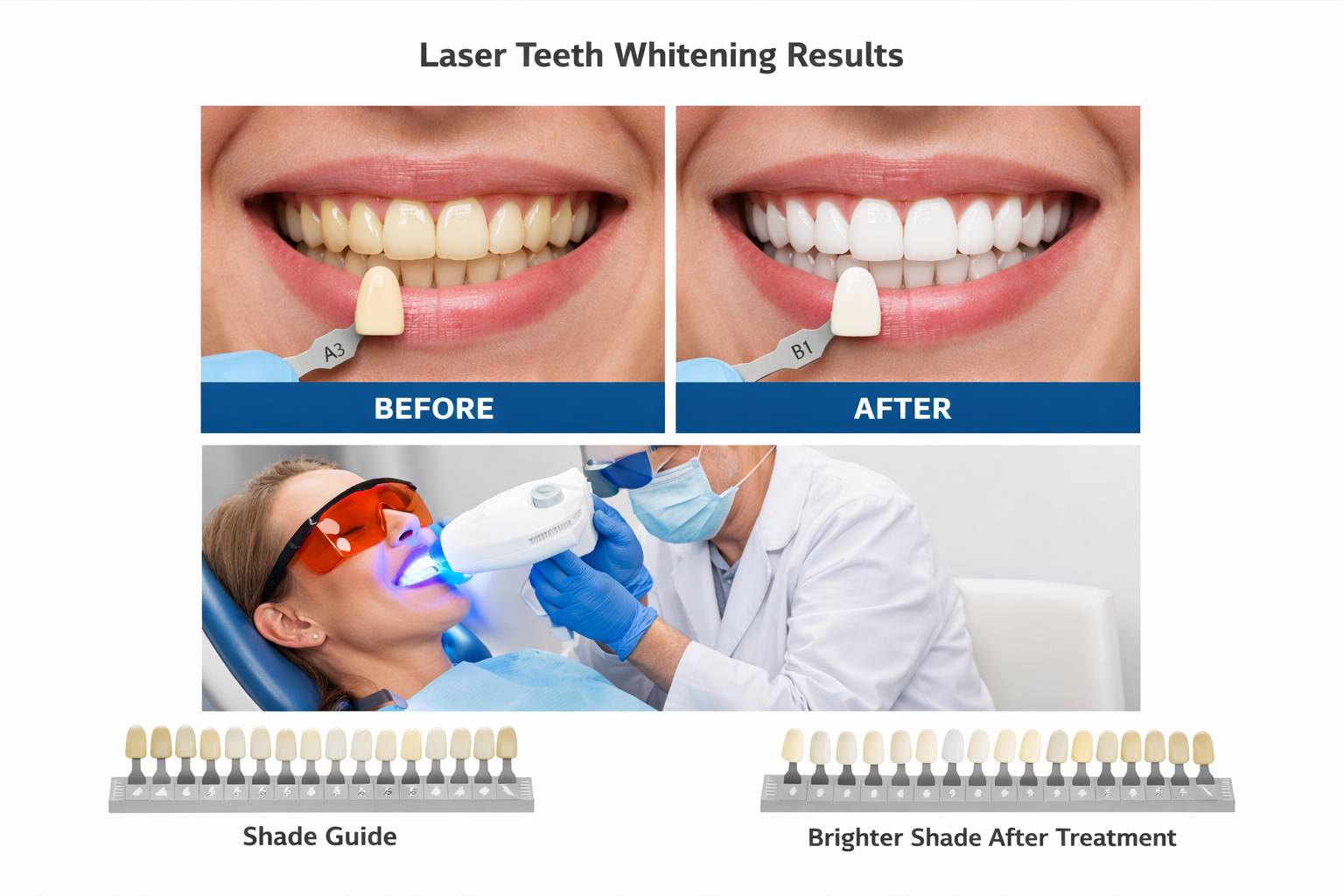
A realistic expectation is a measurable improvement in shade rather than a guarantee of a specific "white" result. Whitening enhances natural teeth rather than creating an artificial, opaque white appearance. The goal is a brighter, fresher look that still appears authentic.
Clinicians use standardised shade guides and repeatable photography under controlled lighting to document baseline and post-treatment results. This objective record helps set realistic expectations and provides a clear measure of change. Photographs help illustrate likely outcomes but are influenced by lighting and camera settings; standardised clinical images are the most reliable indicator.
Immediate visible improvement is common after in-clinic sessions. Maximum noticeable change may develop over the following days as teeth rehydrate and surface effects settle. Additional sessions increase the likelihood of further change in cases where the first session produced a partial improvement.
Before expecting a dramatic transformation, consider whether visible restorations will match the new shade. A staged plan that includes restorative review is often the most aesthetic route for patients with crowns, veneers, or visible fillings.
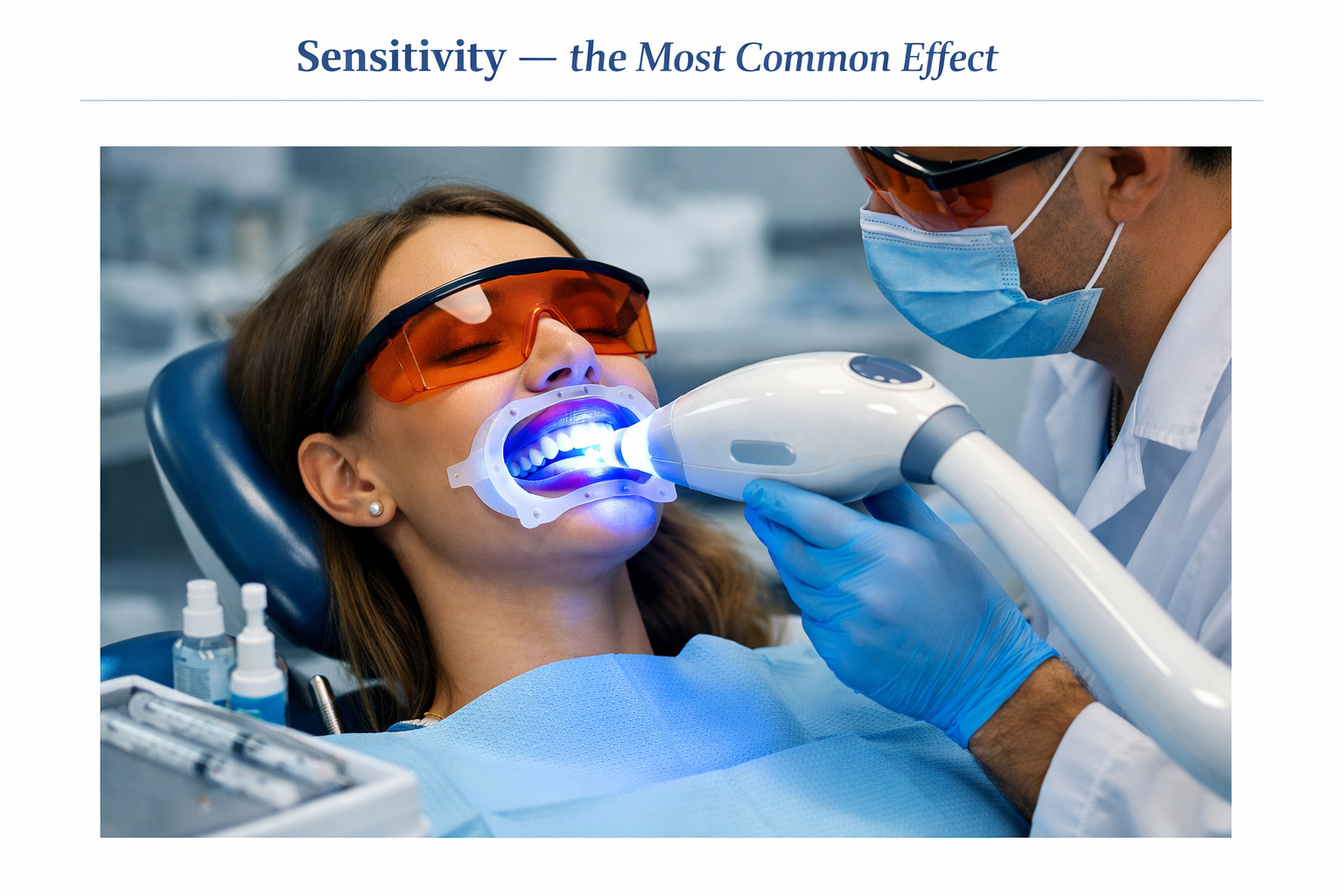
Sensitivity after whitening is the most commonly reported effect. It is usually transient and associated with peroxide penetration into dentine tubules, temporarily affecting nerve responses. Clinicians mitigate sensitivity by using lower concentrations, shortening application times, applying desensitising agents immediately after treatment, and recommending desensitising toothpastes before and after procedures.
If whitening gel contacts gums or soft tissues, it can cause temporary irritation. Proper isolation during the procedure and careful gel placement are key controls. If irritation occurs, clinicians rinse the area and may recommend an appropriate topical soothing agent.
Current evidence suggests that when used correctly under professional supervision, peroxide-based whitening is not associated with lasting harm to enamel structure. The transient changes to enamel surface roughness and tooth mineral content reported in research are typically reversible. A clinician will avoid whitening if there are underlying oral health problems that could be worsened by peroxide exposure.
Very rarely, over-aggressive or unsupervised use of high-concentration products can lead to prolonged sensitivity or soft tissue damage. Professional oversight prevents inappropriate home use and ensures concentrations and exposure times are within safe guidelines. Patients with pre-existing severe sensitivity, cracked teeth, or significant dental work will usually be offered alternative cosmetic plans or staged approaches.
Patients should expect a short period of heightened sensitivity in many cases, and clinicians will outline strategies to reduce it. If sensitivity is intense or persistent after treatment, a follow-up assessment is arranged.
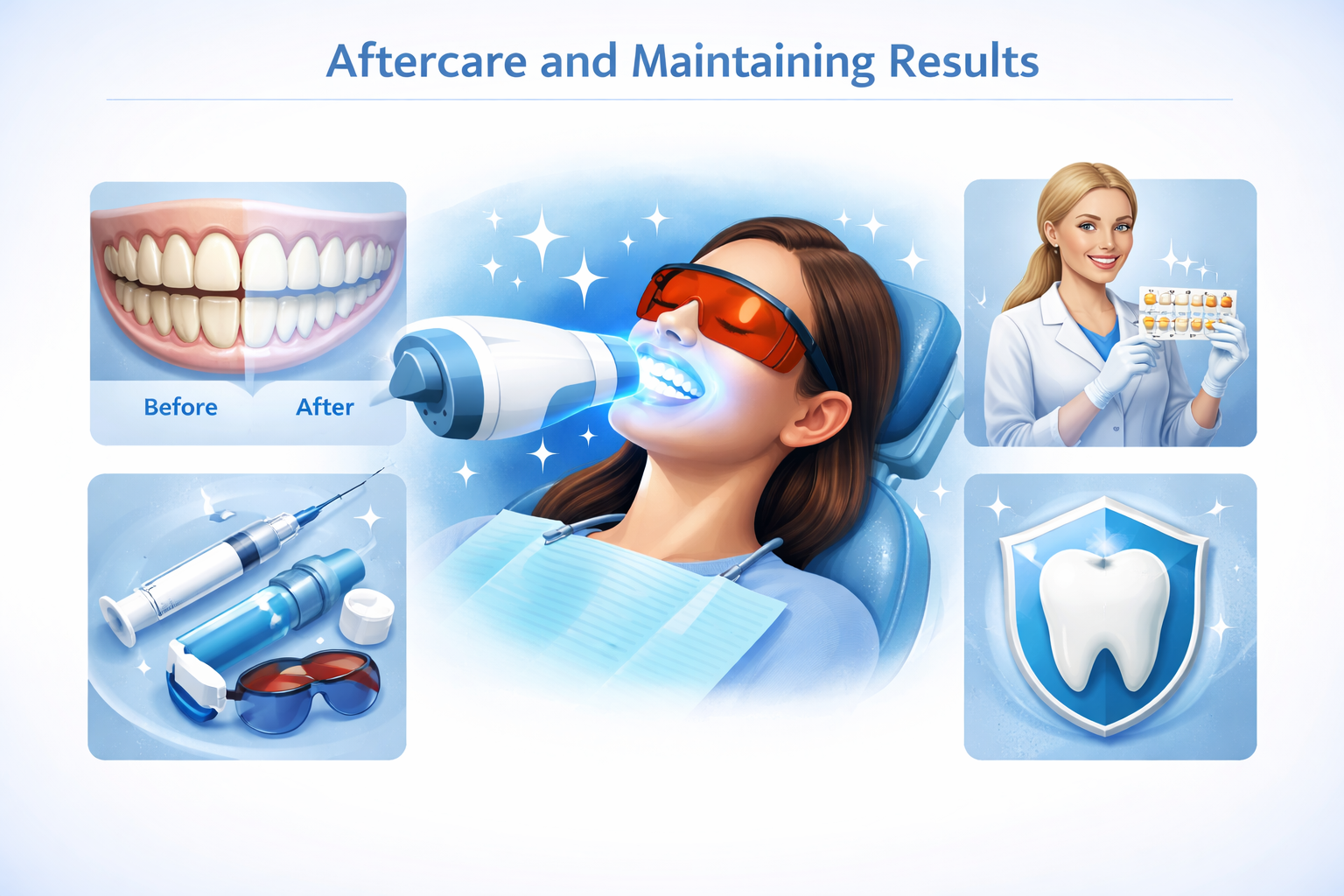
Results depend on lifestyle and oral care habits. Factors that accelerate re-staining include regular consumption of strongly pigmented food and drink — coffee, tea, red wine, berries — tobacco use, and poor oral hygiene. Acidic drinks and some medications can also influence colour relapse.
Avoid highly pigmented food and drink for at least 24–48 hours where possible. Use a non-abrasive fluoride toothpaste and follow any clinician-issued instructions on desensitising agents or temporary dietary modifications.
Good daily oral hygiene and regular professional cleaning help maintain results. Periodic touch-up sessions — either a single in-clinic top-up or a short supervised at-home course — are commonly recommended and effective for many patients. Using professionally recommended whitening toothpaste or lower concentration maintenance gels can slow shade relapse.
Many patients experience good shade retention for months to a few years, with variability driven by the lifestyle habits listed above. A maintenance plan agreed with the clinician will extend the visible benefit and reduce the need for more intensive repeat courses.
When performed by a registered dental professional after appropriate assessment and with correct isolation, peroxide-based whitening with light activation is considered safe for many adult patients. A clinician will advise if the treatment is not suitable for you.
Results vary. Many patients see a noticeable improvement lasting months to a few years. Lifestyle, diet, and smoking have a major influence; maintenance top-ups prolong the effect.
The procedure is typically well tolerated. Short-term sensitivity during or after treatment is common but usually temporary. Clinicians use measures to reduce and manage sensitivity effectively.
Adults in good general and oral health, without active decay or gum disease, and with realistic expectations, are commonly suitable. A clinician's assessment determines individual suitability.
Crowns, veneers, and many fillings do not change shade with whitening. If these restorations are visible in the smile, a clinician will explain how whitening may affect overall appearance and discuss restorative options if necessary.
Many patients achieve a visible change after a single in-clinic session; others may need one or more sessions or a combined in-clinic and take-home regimen. The clinician will advise based on baseline shade and desired outcome.
No. Composite, ceramic, and metal restorations generally do not respond to peroxide whitening and may require replacement to match a new tooth shade.
A measurable improvement is often visible immediately, but the final appearance can settle over days as the teeth rehydrate and any transient surface changes resolve.
"Better" depends on goals. In-clinic treatments deliver faster visible change under supervision; take-home trays provide gradual change with lower concentration agents and may be gentler for some people. A clinician recommends the most suitable option.
When used appropriately under professional guidance, whitening is not associated with lasting enamel damage. Any transient changes are usually reversible, and a clinician will avoid treatment if it might harm tooth structure.
Real perspectives from patients who have undergone clinician-led whitening treatment.
The whole process was calm and professional from start to finish. The clinician explained each step clearly and I felt completely at ease throughout. The results looked natural — exactly what I was hoping for.
I appreciated that the clinician took the time to assess my teeth properly before starting. I had some old fillings and we discussed how the whitening would work around those. Knowing what to realistically expect made a real difference.
I had mild sensitivity for a day or so after treatment, just as the clinician had mentioned. It settled quickly and the improvement in shade was noticeable straight away. Very pleased with the outcome.
Having the treatment supervised by a dental professional gave me confidence that it was being done safely. The aftercare advice was practical and easy to follow. My teeth look brighter and it still looks very natural.
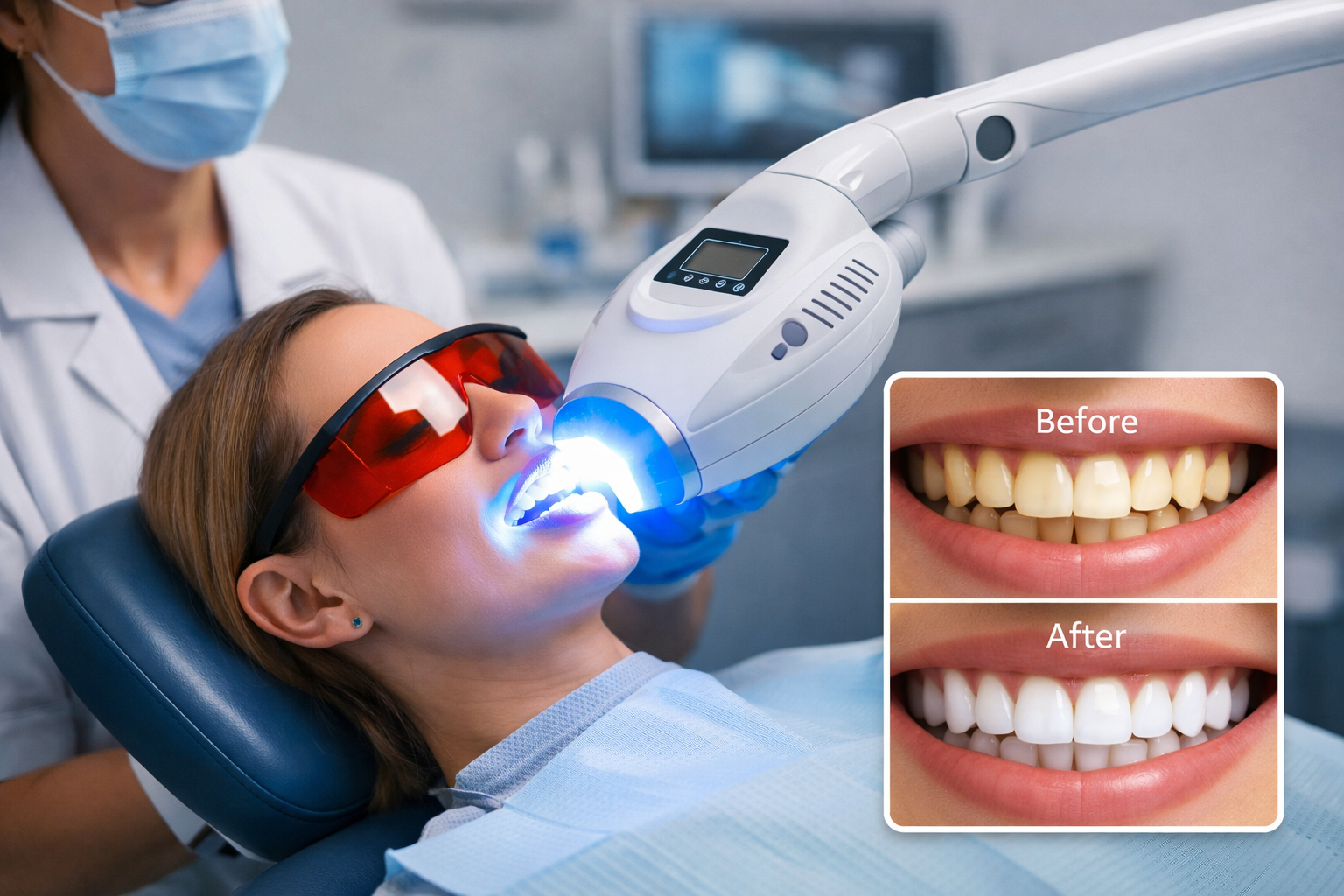
Every treatment begins with a thorough consultation where the registered dental professional reviews general health, medications, and dental history. The mouth is examined for decay, gum health, and existing restorations. A baseline shade is recorded using standardised shade guides and, when appropriate, clinical photographs under consistent lighting.
Patients receive clear information on likely benefits, limitations, and risks. This discussion covers how many sessions might be necessary, what degree of shade change is typical for the individual, and how existing crowns or restorations will behave. Consent is documented; part of that process is establishing baseline sensitivity, so changes can be monitored throughout treatment.
If necessary, any active dental disease is treated first. A professional cleaning is commonly performed to remove plaque and surface deposits; this provides a cleaner surface for the whitening gel and helps set realistic expectations from the outset.
Whitening is not permanent. Many patients find a single course produces a great initial improvement, with periodic top-ups maintaining shade over months to years, depending on habits. A clinician will advise on timing for top-ups and whether a take-home supervised kit is appropriate for maintenance.
While Laser Teeth Whitening is suitable for many adults, certain circumstances mean the treatment should be deferred or an alternative approach considered.
Whitening is generally reserved for adults. Younger patients are usually advised to wait until dental development is complete before considering cosmetic whitening.
Routine elective whitening is usually deferred until after pregnancy and breastfeeding as a precautionary measure.
Decay or active gum disease should be stabilised first. Treatment proceeds once oral health has been restored to a suitable baseline.
Where many teeth are restored, whitening may create an uneven appearance. Restorative dentistry options including veneers, crowns, or composite bonding may be preferable in these cases.
Patients with known peroxide allergy, severe chemical sensitivity, or certain medical conditions will be assessed individually. The clinician will review medical history and seek medical advice where needed to determine the safest approach.
Laser Teeth Whitening is a clinician-led cosmetic dental treatment designed to reduce tooth discolouration in a controlled and medically supervised environment. The process combines a peroxide-based whitening gel with a specialised light or laser activation system. The whitening gel works by penetrating the enamel and breaking down stain molecules within the tooth structure, while the light energy accelerates the chemical reaction, helping to enhance the whitening effect within a shorter clinical session.
Laser Teeth Whitening is most effective for extrinsic staining caused by food, drinks, and smoking. Intrinsic stains — those that originate deeper within the tooth — may respond more gradually or require alternative approaches. During the procedure, protective barriers are placed over the gums and soft tissues to minimise irritation. Some patients may experience temporary sensitivity, but this is typically mild and short-lived when the treatment is properly supervised.
Aftercare plays an important role in maintaining results. Professional guidance on brushing technique, fluoride use, and routine check-ups helps prolong the brightness achieved. It is important to understand that Laser Teeth Whitening aims for natural-looking improvement rather than an artificial, overly bright shade. The goal is to enhance your existing smile safely and responsibly.
If you are considering this option, the next step is to request a clinical assessment. A registered dental professional will review your dental health, discuss your goals, and provide personalised recommendations — ensuring you feel informed, comfortable, and supported throughout the process.